
Review · POMPEII & VESUVIUS TOURS
Pompeii Private Tour with an Archaeologist Guide
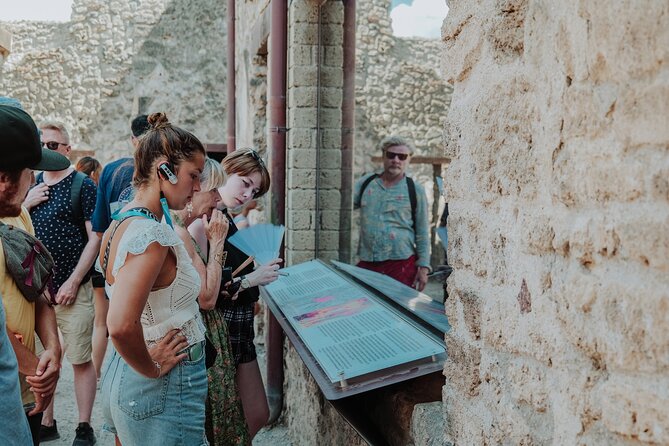
Pompeii makes far more sense when someone helps you read its worn stones, faded paintings, shops, and houses as parts of daily life. This private tour moves through the city with an archaeologist guide who can explain what you are seeing and help you picture how people lived before Mount Vesuvius erupted.
I like the private format, since you can ask questions without waiting for a large group and slow down if someone in your party needs a break. I also like the practical route through major sights, including the Stabian Baths, House of the Faun, Lupanar, and Forum.
The main drawback is time. Two hours gives you a useful introduction, but Pompeii is enormous. You may want to stay for another hour or two after the guide leaves, especially if this is your only visit.
In This Review
- Key things to know before you book
- Why a private archaeologist changes Pompeii
- Meeting at Porta Marina Superiore
- House of the Vettii and Pompeii’s wealthy homes
- Lupanar and the practical side of Roman life
- Theaters, baths, and public entertainment
- Walking Via dell’Abbondanza
- The House of Menander and the Forum Granaries
- Macellum and the heart of the city
- What two hours really gives you
- Price, group size, and value
- Practical details that affect your day
- Who should book this Pompeii tour?
- Should you book it?
- FAQ
- How long does the Pompeii private tour last?
- Where does the tour meet?
- How will I recognize the guide?
- Is the Pompeii entrance ticket included?
- Is transportation included?
- Is this a private tour?
- What should I wear?
- Can I cancel for a full refund?
Key things to know before you book
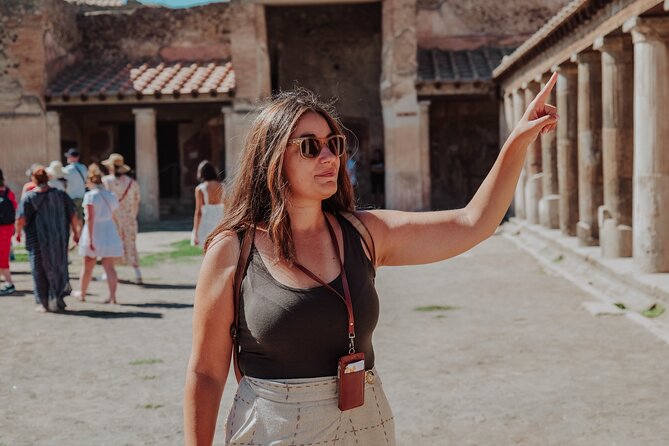
- A real archaeologist leads the visit: Guides including Michele, Paolo, Vito, Antonella, and Mena have been praised for connecting excavated buildings with everyday Roman life.
- The tour covers major Pompeii sights: Expect homes, baths, theaters, shops, streets, public buildings, and the Forum.
- You control the pace: A private group makes it easier to ask questions, pause, or adjust the visit for children and people who need more rest.
- Pompeii admission costs extra: The tour price is $178.45 per person, but the archaeological park ticket is not included.
- Two hours is an orientation, not a full-day visit: The route hits important sites, but you will not see every open corner of the park.
- Wear closed shoes: Ancient streets can be uneven, and flip-flops are a poor match for Pompeii’s rough paving.
Why a private archaeologist changes Pompeii

Pompeii is not a tidy open-air museum with one obvious path. It is a large Roman city with streets, houses, public buildings, shops, fountains, baths, theaters, and working spaces spread across a wide area.
Without context, you can look at a wall painting or a stone counter and simply see an old ruin. A good archaeologist guide helps you ask better questions. What was this room used for? Who could enter it? What does the building tell you about wealth, work, food, religion, or family life?
That kind of explanation is the main reason to choose this tour instead of walking around alone. Guides such as Rossana, Mena, Silvia, Julia, and Paolo have been singled out for making Pompeii understandable and keeping the visit lively. Several guides also use modern comparisons, which can make Roman habits easier to grasp.
The private setup is especially useful for families. Mena, for example, was praised for keeping children interested, while other guides adapted the route for a visitor with a broken foot by moving slowly, finding places to rest, and avoiding dense crowds when possible.
You should still keep your expectations sensible. A private guide cannot make Pompeii small. The site remains exposed, spread out, and physically demanding. The value comes from making the time you have count.
More Naples & Pompeii trips worth a second look
- Pompeii Ruins Private Tour with Optional Skip-the-Line Entry
★ 4.9 · 732 reviews - Pompeii private tour with an Official Guide
★ 5.0 · 631 reviews - Exclusive Naples Private Food Tour: 6 or 10 Tastings
★ 5.0 · 596 reviews
Meeting at Porta Marina Superiore
You meet at the main entrance of Pompeii’s archaeological site, called Porta Marina Superiore, at Via Villa dei Misteri 1 in Pompei. The guide holds an Askos Tours sign, which makes the meeting point easier to identify.
The tour both starts and ends at this address. Transportation is not included, so you must arrange your own way to the entrance. At the end, the guide can offer useful directions for reaching your accommodation or the closest train station.
Give yourself enough time to arrive at the entrance area. The meeting point is clear, but a late start matters on a two-hour tour. You also need to buy your Pompeii admission ticket separately. One booking detail labels the first stop with admission included, but the main tour information clearly says the park entrance is not included. Treat the archaeological ticket as an extra cost, with one past visitor estimating around 20 euros per person. Check the current price before you go.
House of the Vettii and Pompeii’s wealthy homes
The House of the Vettii is one of the early stops, and it gives you a strong introduction to Pompeii’s private architecture. This house is useful for seeing how wealth was displayed through rooms, decoration, and the arrangement of domestic space.
You will not simply be looking at a collection of walls. Your guide can point out how a Roman home worked, where guests might have been received, and how decorated spaces helped communicate status. The visit is scheduled for about 10 minutes, so listen closely and ask specific questions while you are there.
The House of the Faun adds another view of upper-class Pompeii. It is one of the best-known homes on the route and helps show the scale and ambition of a wealthy residence.
I find these houses more interesting when you focus on people rather than architecture alone. Ask your guide what daily life may have looked like for the owners, servants, visitors, and workers connected with the home. One guide, Julia, was also praised for discussing successful businesswomen in Roman society, a useful reminder that Pompeii was not populated only by the military and wealthy male citizens often associated with ancient Rome.
Lupanar and the practical side of Roman life
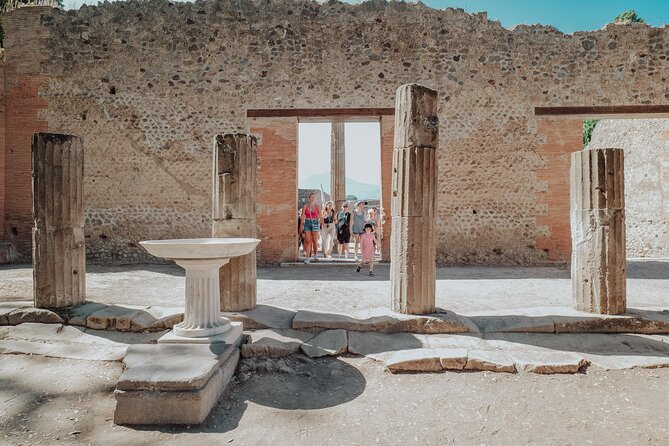
The Lupanar is one of Pompeii’s most famous stops. It attracts attention because of its small rooms and explicit artwork, but a guide adds needed context and helps you separate evidence from guesswork.
This is a brief visit, listed at about 10 minutes. Crowds can gather here, so the private format is helpful when you want a clear explanation instead of a quick glance before moving on.
The tour then takes you to the House and Thermopolium of Vetutius Placidus. The thermopolium was a food counter, often described as an ancient form of fast food. Its presence brings Pompeii down from grand villas and public monuments to the ordinary business of eating, buying, and selling.
This stop is one of the most useful for understanding the city as a living place. Pompeii was not just a collection of grand homes. People worked, bought prepared food, met others, and moved through the streets every day. The ancient food counter also gives your guide a natural opening to compare Roman urban life with familiar modern habits.
A different way to spend the day, same part of Italy:
- Naples: Naples Underground Entry Ticket and Guided Tour
★ 4.4 · 21,781 reviews - Pompeii: Entry Ticket and Guided Tour with an Archaeologist
★ 4.8 · 19,459 reviews - Pompeii: Entry Ticket with Optional Audio Guide
★ 4.2 · 12,360 reviews - Pompeii: Small Group Tour with an Archaeologist
★ 4.8 · 12,264 reviews
Theaters, baths, and public entertainment
The Teatro Grande is a short stop, around five minutes, but it represents an important part of civic life. Pompeii’s theaters were places for performance and public gathering. Even a brief explanation can help you understand how entertainment fit into the city.
The Stabian Baths receive more time, about 10 minutes. These baths were public facilities where people could wash, exercise, socialize, and spend time outside the home. The remains also show how Roman builders managed spaces for different temperatures and uses.
The Forum Baths offer another look at public bathing, this time near Pompeii’s political and commercial center. Seeing both the Stabian Baths and Forum Baths helps you compare different parts of the city rather than treating one bath complex as the whole story.
These stops are also a reminder that Roman public life was highly organized. Baths, theaters, markets, and public squares were not side attractions. They helped shape the rhythm of the city.
Walking Via dell’Abbondanza
Via dell’Abbondanza is one of the most useful stretches for getting a feel for Pompeii’s streets. You walk along a major road rather than viewing isolated buildings one by one.
The street itself shows how people moved through the city and how homes and businesses faced public space. Your guide can help you notice details that are easy to miss when you walk alone, including the way entrances, counters, and doorways relate to the street.
This is where comfortable footwear matters most. Pompeii’s ancient paving can be awkward underfoot, and the site has long stretches of exposed walking. Closed shoes are strongly advised. Flip-flops may be acceptable at a beach, but they are not a wise choice here.
If the sun is strong, the open streets can make the visit tiring. A guide helps by keeping the route focused, but you should still bring water and protect yourself from the heat. The supplied details do not promise shade or refreshments, so plan for an outdoor archaeological site.
The House of Menander and the Forum Granaries
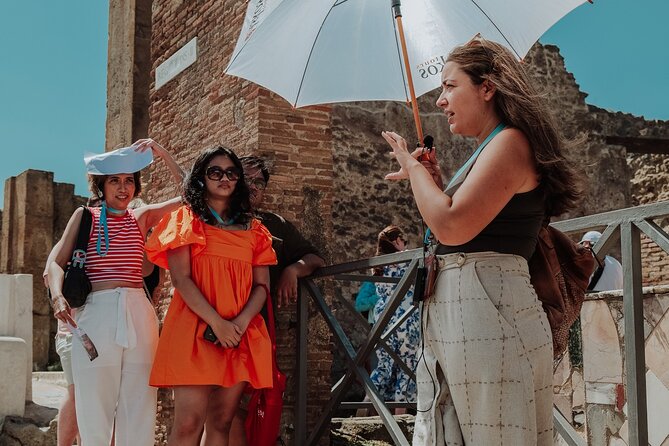
The House of Menander is another important residence on the route. Like the House of the Vettii and House of the Faun, it helps you see how domestic space reflected social position and household life.
The Granaries of the Forum provide a different kind of evidence. Rather than a grand home, this area connects with storage, trade, and the handling of objects and goods. It is a useful counterpoint to the decorated villas because it shows the practical systems that supported Pompeii.
This mix is one of the tour’s strengths. You move from private rooms to food service, from theaters to baths, and from major streets to commercial and storage areas. The result is a broader picture of the city than you would get from visiting only the most famous house.
Macellum and the heart of the city
The Macellum was a market building in the Forum area. It helps explain how food and trade fit into the center of Pompeii.
The stop is short, about five minutes, so you should use your guide’s explanation to focus on the building’s purpose and position. A market beside the Forum tells you a great deal about how public, political, religious, and commercial life overlapped.
The Forum itself comes near the end of the route. This is the city’s great public center, and it can be hard to take in without guidance. You may see columns, temples, administrative buildings, and open space, but the guide helps you understand how these parts related to one another.
I like ending at the Forum because earlier stops give you a working idea of Pompeii before you reach its main civic stage. After seeing homes, businesses, baths, and streets, you can better imagine the people who gathered here and the activities that shaped public life.
What two hours really gives you
The schedule allows about 10 minutes at most stops, with shorter visits at the theater and Macellum. That is enough for an organized introduction, especially if you have only half a day in Pompeii.
It is not enough for every room, every painting, or every section of the archaeological park. One visitor wished for a four-hour visit because the site is so large. That is a fair criticism, but it also points to the tour’s proper role: this is a guided highlights route, not a complete exploration.
If you have limited time, I think two hours is a sensible compromise. You get a clear route and expert explanation, then you can continue alone after the tour. Several guides provide suggestions for other areas worth seeing, which makes the final hour or two easier to plan.
If you have a full day, consider this tour as your first two hours. Let the guide give you the framework, then revisit areas that interest you. The private format allows you to ask where to go next rather than wandering without a plan.
Price, group size, and value
The listed price is $178.45 per person. That is a serious cost, particularly for a pair, and the separate Pompeii entrance ticket increases the total. The value depends heavily on your group size and your interest in history.
For two people, the per-person price may feel high. For a family or larger private group, group discounts can improve the calculation. You are paying for an archaeologist guide’s time, a private route, and the chance to shape the conversation around your interests.
I would not choose it simply to save money. I would choose it because Pompeii is easy to misread and hard to cover efficiently. Guides such as Antonella have encouraged visitors to think like archaeologists, while Vito and Paolo have been praised for bringing ancient life into clearer focus. That personal explanation is what separates this from an audio guide or a casual walk.
The tour is also useful for mixed-age groups. Children may need stories and questions to stay engaged. Adults may want architecture, social customs, food, or archaeology. With only your group present, you can steer the guide toward the subjects that matter most to you.
Practical details that affect your day
Confirmation arrives at booking. The experience is offered in English, and only your group takes part.
Most people can participate, but the ruins involve substantial walking over uneven ground. Wear closed shoes and use the private pace to your advantage. If someone in your party has mobility concerns, mention it at the start so the guide can slow down and include rest points where possible.
Service animals are allowed, and the site is near public transportation. No transportation is supplied by the tour itself.
The cancellation policy is generous if your plans may change: you can receive a full refund by canceling at least 24 hours before the start time. Changes or cancellations inside that window are not accepted for a refund, and local time controls the cut-off.
Who should book this Pompeii tour?
I would recommend it most strongly to first-time visitors, families, people with limited time, and anyone who wants answers rather than a silent walk through ruins. It is also a good fit if you care about daily life, not just famous buildings.
The tour can suit repeat visitors too, especially if you want an archaeologist’s perspective or a slower visit tailored to a particular interest. Guides have covered subjects ranging from Roman businesswomen to food counters and household life.
I would hesitate if you want to spend a full day at Pompeii with no schedule, or if the price feels uncomfortable after adding admission. You may prefer to enter independently and explore at your own pace.
For most people, the best plan is to treat the two-hour tour as your foundation. Afterward, stay in the park and continue on your own. The guide gives you the map in your head, which is often what Pompeii lacks.
Should you book it?
Book this private Pompeii tour if you want the ruins explained by an archaeologist, have only a few hours, or are visiting with children or different walking speeds. The strongest benefit is the personal attention, supported by guides such as Rossana, Mena, Jolanta, Paolo, and Silvia, who have been praised for clear explanations, warmth, and good pacing.
Skip it if you are determined to keep costs low or already know Pompeii well. Otherwise, I think the private format earns its place in a carefully planned visit, as long as you budget separately for admission and leave extra time to explore beyond the guided route.
FAQ
How long does the Pompeii private tour last?
The tour lasts approximately two hours.
Where does the tour meet?
You meet at Porta Marina Superiore, the main entrance to Pompeii’s archaeological site, at Via Villa dei Misteri 1, 80045 Pompei, Italy.
How will I recognize the guide?
The guide will hold a sign with Askos Tours written at the top.
Is the Pompeii entrance ticket included?
No. The Pompeii entrance ticket is not included in the tour price and must be purchased separately.
Is transportation included?
No. Transportation of any kind is not included. The tour starts and ends at the Pompeii archaeological site entrance.
Is this a private tour?
Yes. Only your group participates in the activity.
What should I wear?
Closed shoes are recommended because the ruins can be difficult to walk through in open shoes or flip-flops.
Can I cancel for a full refund?
Yes, if you cancel at least 24 hours before the experience start time. Cancellations or changes made less than 24 hours before the start time are not accepted for a refund.
Recently reviewed around Naples & Pompeii
- Pompeii Skip-the-line Tour with Archaeologist Guide★ 5.0 · 559 reviews
- Sharing Tour of Pompeii★ 5.0 · 487 reviews
- Skip the Line Guided Tour of Pompeii led by an Archaeologist★ 5.0 · 703 reviews
- Visit in Pompeii – Pompeii Private Tour with Ada★ 5.0 · 436 reviews
- Pompeii Private Tour with an Archaeologist and Skip The Line★ 5.0 · 391 reviews
- Private Day Tour to Vesuvius, Herculaneum & Pompeii with Pick Up★ 5.0 · 279 reviews
- Pompeii Vineyard Escape: Private Wine Tasting & Lunch★ 5.0 · 329 reviews
- Pompeii Guided Group Tour with Entry Ticket and Archaeologist★ 4.5 · 269 reviews
Pompeii & Vesuvius Tours, compared.

Entry Ticket and Guided Tour with an Archaeologist
Read our review →




Pompeii Small Group Tour with an Archaeologist
Read our review →
Pompeii, Amalfi Coast and Positano Day Trip from Rome
Read our review →Browse the lists this tour appears in