
Review · POMPEII & VESUVIUS TOURS
Pompeii: Skip-the-Line Guided Tour with Expert Archaeologist
Pompeii makes far more sense when someone can read its worn stones, faded signs, and strange household details for you. I like that this tour uses an official archaeologist guide, and I like the three-hour option, which gives you time to move beyond the famous Forum and see how ordinary Romans lived. The main drawback is simple: Pompeii is huge, hot, dusty, and short on shade.
I also appreciate the small-group format and headsets, which mean you can hear the guide without pressing into a crowd. Just arrive at the correct gate, bring water and sun protection, and expect a serious amount of walking over uneven ancient streets.
In This Review
- Key points to know before booking
- Why an archaeologist changes Pompeii
- Meeting at the Villa dei Misteri entrance
- The first streets reveal a living Roman town
- The Forum, Temple of Apollo, and public heart of Pompeii
- Bakeries, shops, and an ancient supermarket
- Baths, villas, and the private side of town
- The casts and Pompeii’s hardest moment
- The old walls and views toward Naples
- Recent excavations keep the route changing
- The optional brothel stop
- Three hours or two hours?
- Who will enjoy this tour most?
- Should you book the Pompeii archaeologist tour?
- FAQ
- Where does the Pompeii tour meet?
- How early should I arrive?
- How will I identify the guide?
- How long does the tour last?
- What is included in the price?
- Is hotel transportation included?
- Is the tour available in English?
- Can I choose a private tour or small group?
- What should I bring?
- Is the tour suitable for wheelchairs or strollers?
Key points to know before booking
- An archaeologist leads the walk: Guides such as Ilaria, Anna, Enzo, Brunella, and Sonia have been praised for clear explanations, humor, and a strong grasp of Pompeii.
- The three-hour route goes beyond the main sights: You may see bakeries, baths, houses, shops, a cemetery, the old walls, and newer excavation areas.
- The two-hour Express option is a tighter introduction: It focuses on the Forum, temples, and shops.
- Skip-the-line entry saves useful time: Pre-reserved tickets help you get into the archaeological park without waiting in the regular ticket line.
- Summer conditions are demanding: Shade is limited, so wear light clothing, sturdy shoes, a hat, sunscreen, and carry plenty of water.
- The tour is not suitable for wheelchairs or strollers: You need to walk at a moderate pace over the ancient site.
Why an archaeologist changes Pompeii
Pompeii is not a single monument. It is a whole Roman town spread across a vast archaeological park, with streets, homes, businesses, temples, baths, public buildings, and city walls. On your own, you can walk past a doorway or a row of stones without knowing what you are seeing.
That is where this tour earns its fee. A trained archaeologist can explain how a bakery worked, why a street was laid out in a certain way, and what a building tells you about class, trade, religion, or daily routine. The best guides do not simply recite dates. They connect the remains to people who lived, worked, ate, worshiped, argued, and died here.
The guides have different personalities, but the strongest common thread is their ability to make complicated archaeology easy to follow. Ilaria has been singled out for her humor, precision, and ability to keep children engaged. Anna has been praised for clear English and lively stories. Enzo is known for telling information through stories, while Brunella brings the authority of an archaeologist without rushing the group.
That human touch matters at Pompeii. The site can feel quiet and overwhelming at the same time. A good guide gives you a route, a timeline, and a reason to care about each stop.
More Naples & Pompeii trips worth a second look
- Herculaneum: Skip-the-Line Guided Tour with Archaeologist
★ 4.8 · 3,439 reviews - Mount Vesuvius: Skip-the-Line Ticket and Smart Digital Guide
★ 4.2 · 2,780 reviews - From Naples: Pompeii Skip-the-Line Entry Ticket and Tour
★ 4.4 · 2,753 reviews
Meeting at the Villa dei Misteri entrance
The tour begins at Via Villa dei Misteri, 1, at the entrance gate for Pompeii Archaeological Park. The meeting point is across from the Hortus Pompei restaurant, and the guide carries a green Walks sign.
Arrive 15 minutes early. One practical point deserves extra attention: the meeting instructions need to be clear in your mind before you set out. A past participant found the initial guide identification and end point a little unclear, so do not rely only on a map pin. Look for the specified entrance and the green sign.
The tour returns to the same general location at Via Villa dei Misteri, 1. Hotel transportation is not included, so you arrange your own way to and from Pompeii.
Pre-reserved skip-the-line tickets are included. That does not make the park small, but it can spare you from wasting valuable time at the entrance. For a visit lasting only two or three hours, that time matters.
The first streets reveal a living Roman town

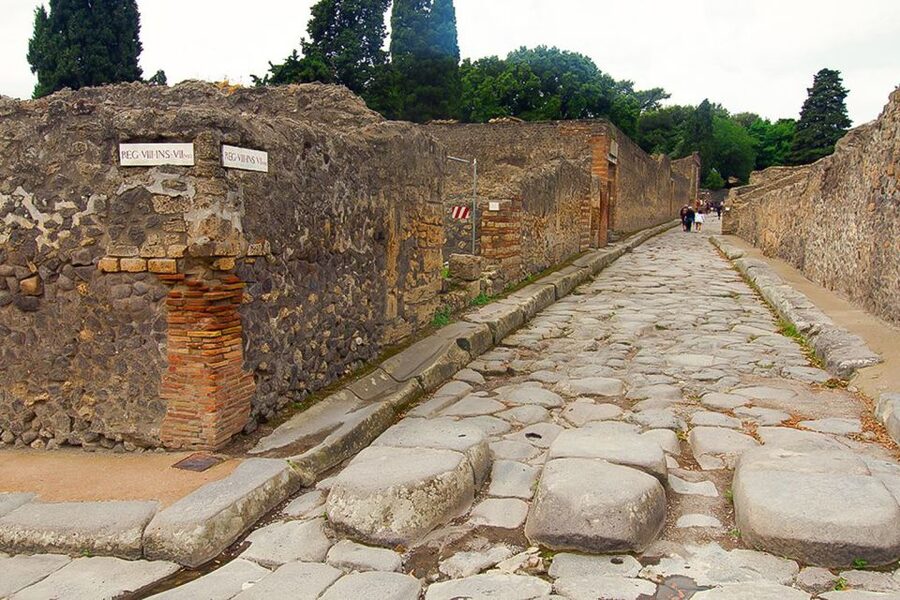
Once inside, you begin walking through Pompeii’s preserved streets. The town was buried by the eruption of Mount Vesuvius in 79 AD, preserving an unusually direct picture of Roman urban life.
Look down as well as around you. The streets, walls, thresholds, and building fronts help show how people moved through town and how shops faced the public. You may pass remains of businesses, private homes, temples, public baths, and places tied to food production.
Without a guide, many of these structures can look like piles of brick. With an archaeologist beside you, small clues become useful. A counter can suggest a food shop. A layout can reveal the difference between a private room and a public space. A faded feature that seems decorative may have had a practical purpose.
The group usually pauses at important buildings rather than rushing through them. Headsets are supplied when needed, which is particularly useful when the site is crowded or when you are standing several steps away from the guide.
The Forum, Temple of Apollo, and public heart of Pompeii
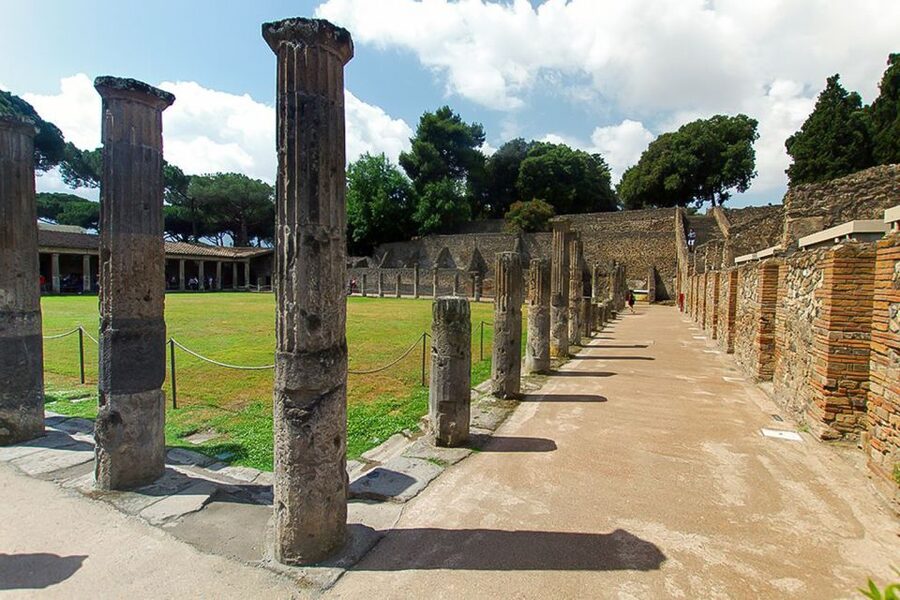
The Roman Forum is one of the essential stops. This was the public center of Pompeii, where political, religious, and commercial life came together. It is also one of the places where the scale of the city becomes easier to grasp.
The Temple of Apollo adds an older religious layer to the story. Here, the guide can help you see Pompeii as a changing city rather than a frozen display. Different structures and building styles reflect the town’s long development before the eruption.
I like this part of the route because it gives you the broad picture. The Forum tells you how the city functioned in public. The smaller streets and homes later show how that public life filtered into everyday routines.
The tradeoff is that these famous areas can attract many groups. A small group and a headset help, but you should still expect pauses, foot traffic, and occasional noise.
A different way to spend the day, same part of Italy:
- Naples: Naples Underground Entry Ticket and Guided Tour
★ 4.4 · 21,781 reviews - Pompeii: Entry Ticket and Guided Tour with an Archaeologist
★ 4.8 · 19,459 reviews - Pompeii: Entry Ticket with Optional Audio Guide
★ 4.2 · 12,360 reviews - Pompeii: Small Group Tour with an Archaeologist
★ 4.8 · 12,264 reviews
Bakeries, shops, and an ancient supermarket
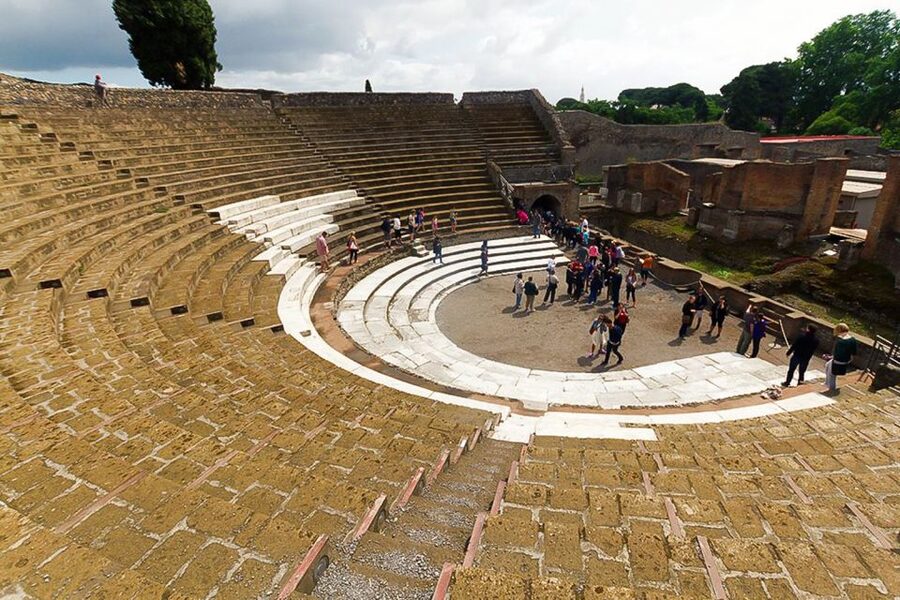
The most memorable Pompeii stops are often the ordinary ones. The remains of a Roman bakery show food production in a way that feels surprisingly close to modern life. The tour also visits shops and an ancient supermarket, giving you a look at how residents bought and prepared daily necessities.
This is where the visit moves beyond emperors and grand temples. Most people in Pompeii did not spend their day in a monument. They worked in shops, bought food, lived above or behind businesses, and used the town’s public facilities.
A guide can point out details you would probably miss, then explain what they suggest. That kind of interpretation is the real reason I would choose a guided visit here. You are not just looking at old walls. You are learning how a town operated.
Families can benefit from this section, since food, shops, and household routines are easier for children to picture than an abstract lecture about Roman politics. Sonia, for example, was praised for answering children’s questions and keeping an eight-year-old interested throughout the three-hour route. The quality of the experience will depend on the guide assigned to your departure, but the format allows time for questions.
Baths, villas, and the private side of town
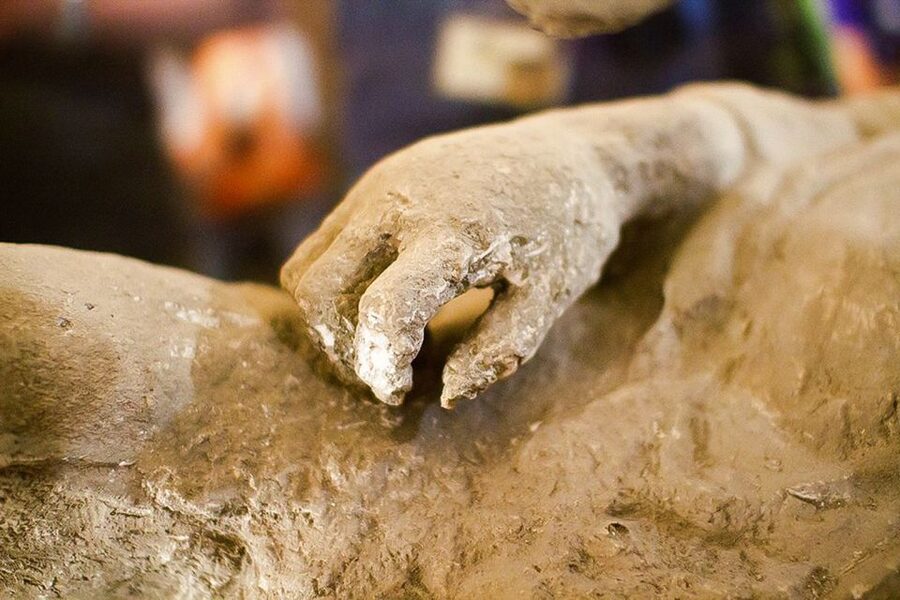
Pompeii’s houses and baths show the gap between public display and private routine. Villas can reveal wealth through size, decoration, and layout, while smaller homes and work spaces show a more modest side of Roman life.
The public baths are important not only as architectural remains but also as social spaces. They help explain how Romans spent free time, met other people, and treated bathing as part of city life.
Your guide may connect the buildings to the Roman Republic and explain how social rank shaped daily experience. The point is not to memorize a list of rooms. It is to understand that Pompeii was a functioning community with different types of residents and businesses.
The three-hour route is the better choice if these contrasts interest you. The two-hour Express option gives you a useful introduction, but its focus is the Forum, temples, and shops. It is less suited to someone who wants a broad look at houses, baths, food production, and outer areas.
The casts and Pompeii’s hardest moment
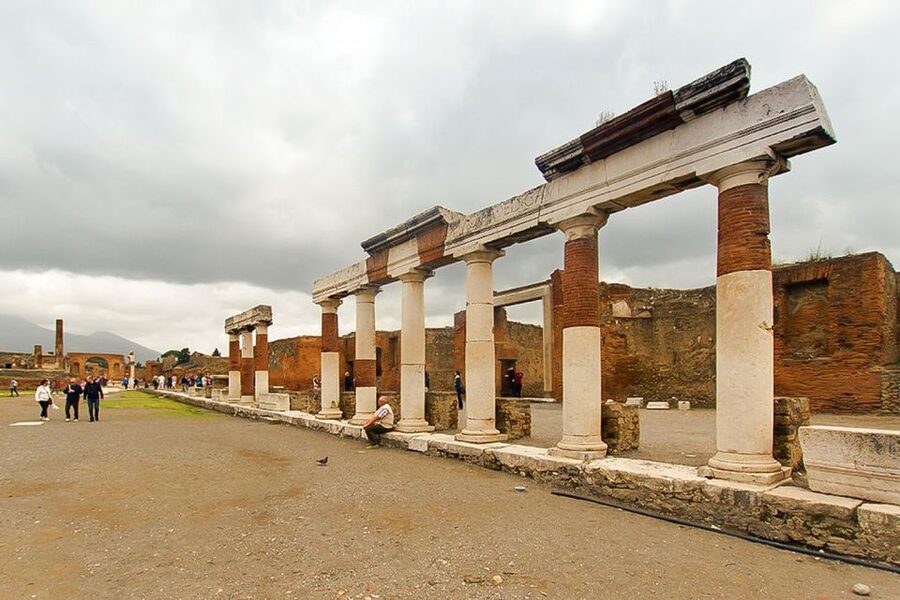
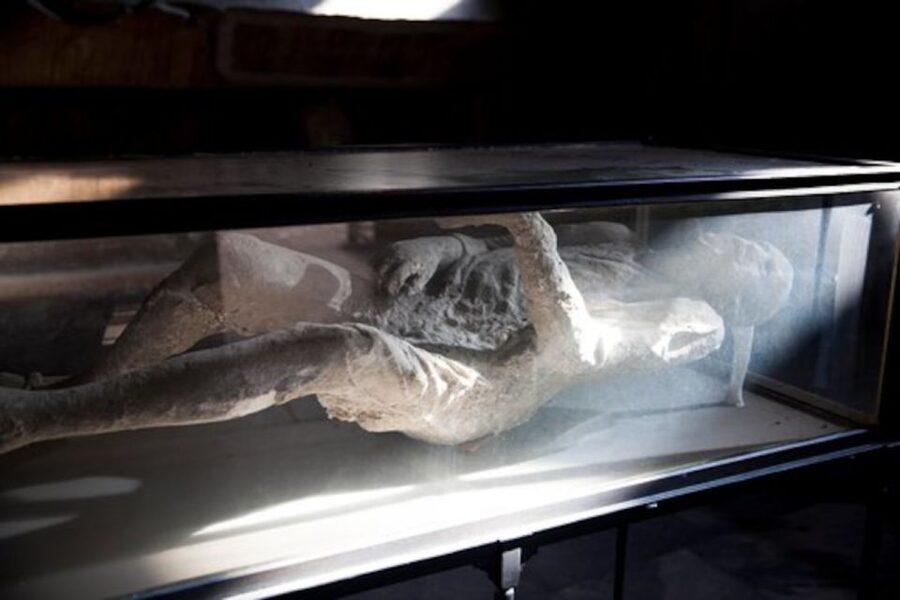
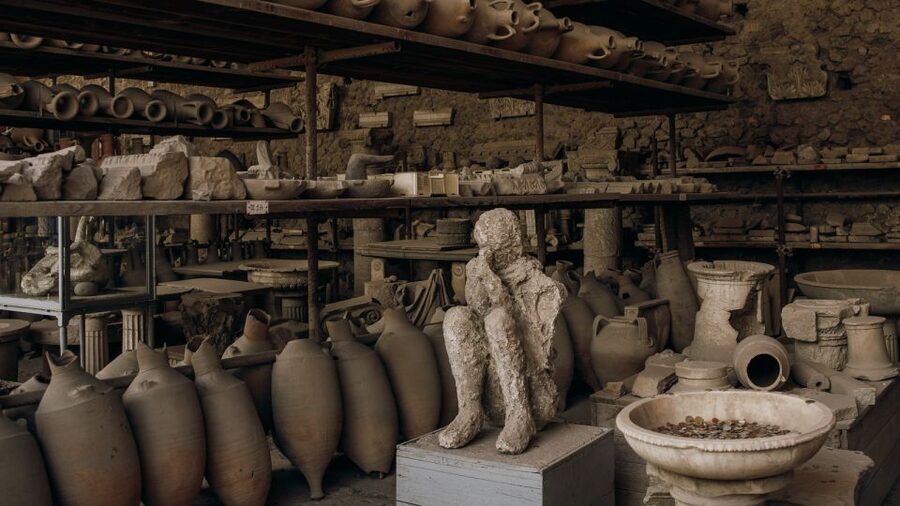
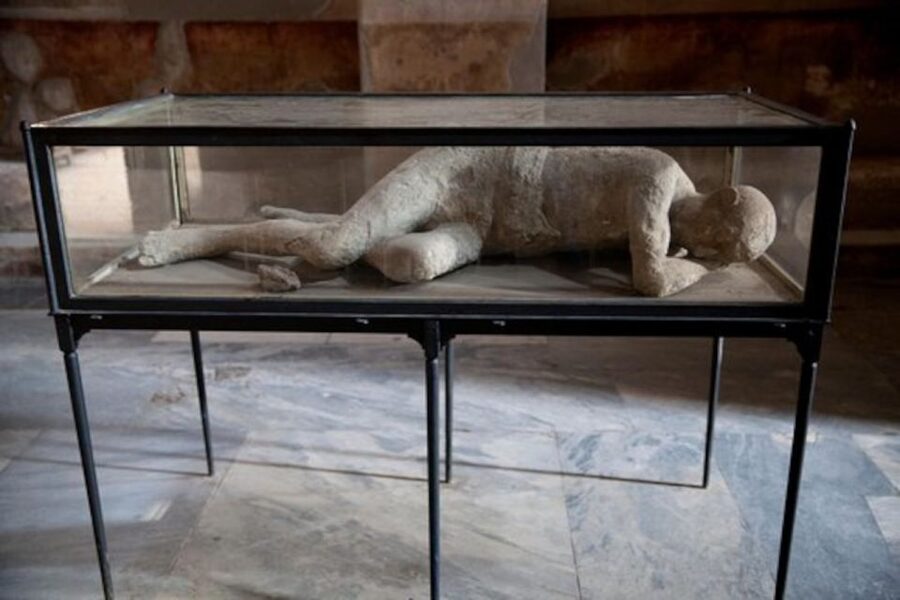
The plaster casts are among the most emotional sights in the park. They preserve the forms of people caught in the eruption, giving a human shape to an event that can otherwise feel distant.
This section deserves a thoughtful guide. The casts are not simply dramatic objects to photograph. They represent individual lives interrupted with no warning. An archaeologist can explain how the casts were made and place them within the wider evidence of the eruption and the city’s final hours.
You may find this part difficult. Pompeii is often presented as an archaeological wonder, but it is also a site of death. The tour does not allow you to forget that behind the streets and buildings were families, workers, and neighbors.
The same is true of the old cemetery. It adds another layer to the city’s story, showing how Pompeii marked the boundary between daily life and the world of the dead.
The old walls and views toward Naples
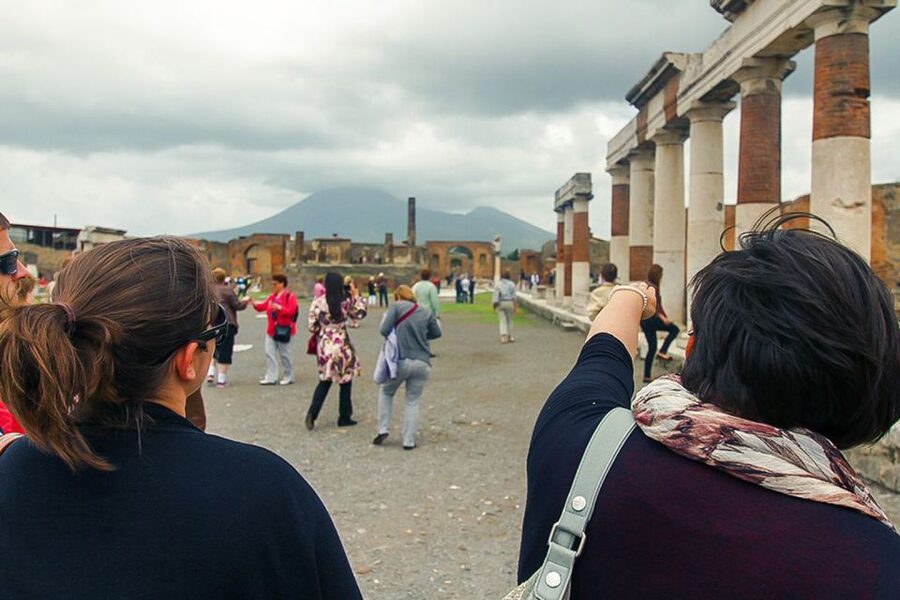
The tour may continue along the old city walls, where you get panoramic views toward Naples. This is a useful change of pace after walking through enclosed streets and buildings.
From the walls, Pompeii’s position becomes easier to understand. You can look outward toward the surrounding area and consider the city as a real settlement, not just an isolated excavation. The view also offers a welcome sense of space.
Do not expect a long rest here. The overall route continues at a moderate walking pace, and the site provides limited shade. In warm weather, the walls can feel exposed, even if the view is excellent.
Several people who took the tour in summer found the heat to be the main challenge. One practical suggestion was to bring a UV-protective umbrella, though a hat and sunscreen are also sensible. Closed-toe shoes are a good choice, especially on uneven surfaces.
Recent excavations keep the route changing
About one-third of Pompeii remains uncovered, and excavation and preservation work continue. That gives this tour a useful quality: the archaeological story is still developing.
The guide can explain how discoveries are made, how exposed structures are protected, and why some areas open or close as work progresses. The exact route may shift as new areas become available or preservation needs change, so you should not treat every departure as a fixed checklist.
Some departures have included access near a newly opened archaeological dig. That kind of stop is especially valuable because it lets you see Pompeii as an active research site rather than a finished museum.
This also means the phrase see more depends on the option you book and the conditions on the day. The Complete Pompeii route is the longer choice and is intended to cover more of the park. Still, no three-hour visit can cover every corner of a site this large. If you want to explore independently afterward, leave room in your day.
The optional brothel stop
An old brothel may be included when appropriate for the group. This is one of Pompeii’s better-known examples of how archaeology can reveal subjects that polite public history sometimes skips.
The stop may not suit every family or group, particularly with younger children. The tour description makes clear that it depends on what is appropriate for your group, so do not assume it will be part of every route.
If it is included, the guide can place it in the wider context of Roman commercial and social life. As with the rest of Pompeii, the value comes from explanation. A building’s function and design can tell you much more than a quick glance from the doorway.
Three hours or two hours?
At $70 per person, this is not the cheapest way to enter Pompeii. It can still be good value if you want the site explained rather than simply visited.
The longer three-hour route is the one I would choose for a first visit. Pompeii is too large for a quick look, and the extra hour gives the guide space to include more streets, homes, baths, shops, food-related buildings, the cemetery, and possibly newer excavation areas.
Choose the two-hour Express option if your schedule is tight, your group includes people who tire easily, or you mainly want the Forum, temples, and shops. It is a shorter introduction, not a full survey of the park.
The small-group format improves the value. You can hear the guide, ask questions, and keep moving without the feel of a huge tour party. Private and small-group options are available, though the price and format should be checked for your selected booking.
Who will enjoy this tour most?
I would recommend it to first-time visitors, history fans, families who want the ruins explained, and anyone who finds large archaeological sites confusing. It is also a good fit if you want current excavation work included rather than a standard route through only the famous monuments.
Children can enjoy it when the guide tells stories and welcomes questions. Several guides have been praised for making the subject lively for younger members of the group. Still, the heat and walking may be harder for small children than the history itself.
This is not the right choice for someone who needs a wheelchair, stroller, or a fully accessible route. The ancient streets are uneven, and the activity is specifically described as unsuitable for people with mobility impairments. High-heeled shoes are not allowed, and comfortable walking shoes are essential.
Bring a passport or ID card, including the required ID for children. Full participant names must match the names on the booking documents and passports or identity cards, and name changes are not permitted.
Should you book the Pompeii archaeologist tour?
Book it if you want Pompeii to become a city rather than a collection of ruins. The archaeologist guides are the major strength, and the three-hour option offers enough time to connect public monuments with shops, bakeries, baths, homes, cemeteries, and the people behind the plaster casts.
I would choose the full route for $70 if Pompeii is a major part of your Campania plans. Choose Express only when time or stamina is limited. Either way, arrive early at the Villa dei Misteri entrance, confirm the green sign, wear sturdy shoes, and carry more water than you think you need.
FAQ
Where does the Pompeii tour meet?
The meeting point is at the Entrance Gate for Pompeii Archaeological Park on Via Villa dei Misteri, 1, across from the Hortus Pompei restaurant.
How early should I arrive?
Arrive 15 minutes before the scheduled start time.
How will I identify the guide?
The guide will be holding a green Walks sign.
How long does the tour last?
The full experience lasts about three hours. The Express option lasts about two hours.
What is included in the price?
The price includes pre-reserved skip-the-line Pompeii tickets, an official Pompeii tour guide, and headsets when needed.
Is hotel transportation included?
No. Hotel pickup and drop-off are not included.
Is the tour available in English?
Yes. The listed live guide language is English.
Can I choose a private tour or small group?
Yes. Private and small-group formats are available.
What should I bring?
Bring a passport or ID card, comfortable shoes, water, sun protection, and identification for children.
Is the tour suitable for wheelchairs or strollers?
No. The tour is not suitable for wheelchair users, strollers, or people with mobility impairments. It involves walking at a moderate pace over the archaeological site.
Recently reviewed around Naples & Pompeii
- Pompeii Skip-the-line Tour with Archaeologist Guide★ 5.0 · 559 reviews
- Sharing Tour of Pompeii★ 5.0 · 487 reviews
- Skip the Line Guided Tour of Pompeii led by an Archaeologist★ 5.0 · 703 reviews
- Visit in Pompeii – Pompeii Private Tour with Ada★ 5.0 · 436 reviews
- Private Day Tour to Vesuvius, Herculaneum & Pompeii with Pick Up★ 5.0 · 279 reviews
- Pompeii Private Tour with an Archaeologist and Skip The Line★ 5.0 · 391 reviews
- Pompeii Vineyard Escape: Private Wine Tasting & Lunch★ 5.0 · 329 reviews
- Pompeii Guided Group Tour with Entry Ticket and Archaeologist★ 4.5 · 269 reviews
Pompeii & Vesuvius Tours, compared.

Entry Ticket and Guided Tour with an Archaeologist
Read our review →




Pompeii Small Group Tour with an Archaeologist
Read our review →
Pompeii, Amalfi Coast and Positano Day Trip from Rome
Read our review →Browse the lists this tour appears in