
Review · POMPEII & VESUVIUS TOURS
Pompeii: Small-Group Tour of Pompeii and Herculaneum
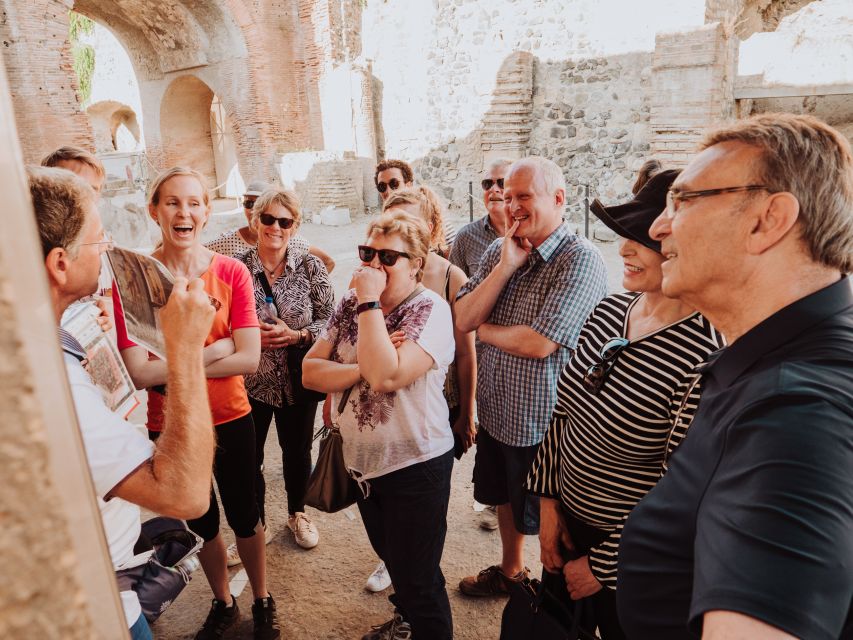
Pompeii shows a Roman city stopped in its tracks. Herculaneum, buried under a much thicker flow of mud, preserves finer details: upper floors, painted walls, mosaics, and carbonized wood. With an archaeologist guide, you get more than a walk among old stones. You get the social clues that explain how these cities worked.
I like the smart pairing of the two sites and the small group, capped at 20 people. I also like that entry tickets are handled for you, so you can focus on the ruins instead of ticket counters. The main drawback is the short 30-minute lunch break after Pompeii. After two hours on rough paving stones, you may want a proper sit-down meal and a little shade.
In This Review
- Key points to know before booking
- Why seeing both ruins makes sense
- Meeting at Porta Marina Inferiore
- Two hours inside Pompeii
- The 30-minute pause after Pompeii
- The train from Pompeii to Ercolano
- Two hours at Herculaneum
- What the guides add
- How much value do you get?
- Who should book this tour?
- Practical tips for a smoother visit
- Should you book it?
- FAQ
- How long does the Pompeii and Herculaneum tour last?
- Where does the tour begin?
- How do I recognize the guide?
- Which languages are available?
- Are entry tickets included?
- How do I travel from Pompeii to Herculaneum?
- Does the tour return to Pompeii?
- Is lunch included?
- Is the tour suitable for wheelchair users?
Key points to know before booking
- Two cities, two very different stories: Pompeii is huge and urban, while Herculaneum is smaller and preserves more delicate details.
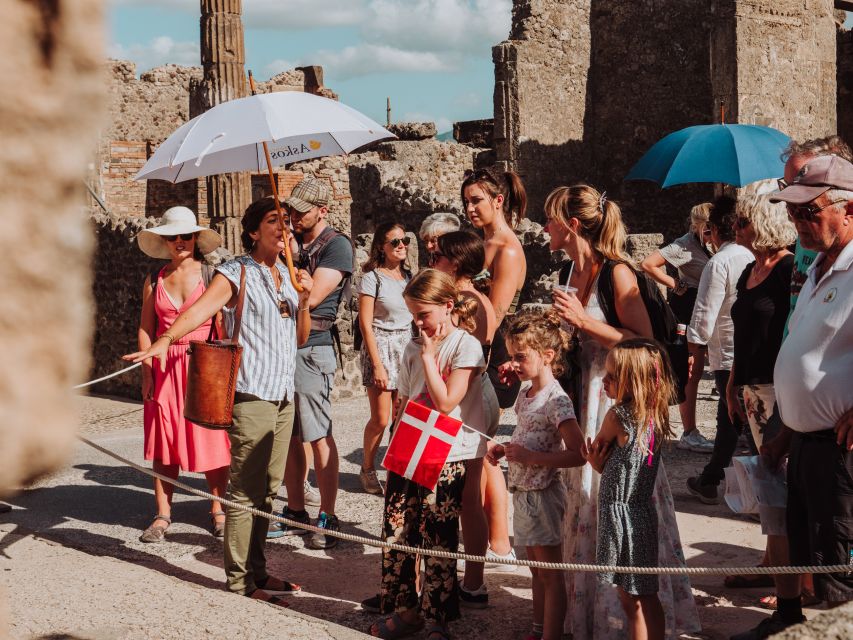
- Archaeologist-led walks: Guides including Diego, Paolo, Alfredo, Sergio, Julia, and Vincenzo have been praised for clear explanations, humor, and strong knowledge of the sites.
- Maximum group of 20: This is not a private tour, but it is far easier to follow than a large coach group.
- A short train transfer: The Circumvesuviana train connects Pompeii with Ercolano in roughly 20 minutes, with the schedule allowing about 30 minutes.
- The tour ends at Herculaneum: You must arrange your own onward transport, including your return to Pompeii.
- Expect a lot of walking: Comfortable shoes, water, a hat, and sun protection are important, especially in summer.
Why seeing both ruins makes sense
Pompeii and Herculaneum were both overwhelmed by Mount Vesuvius in 79 A.D., but the disaster affected them in different ways. Pompeii was covered by roughly four meters of pumice and volcanic ash. Herculaneum was buried beneath an avalanche of mud around 20 meters thick.
That difference is the key to the day. Pompeii gives you scale. You walk through a full Roman town with streets, public spaces, homes, and businesses spread across a large archaeological area. It can be hard to know where to look, and the size alone can leave you overloaded.
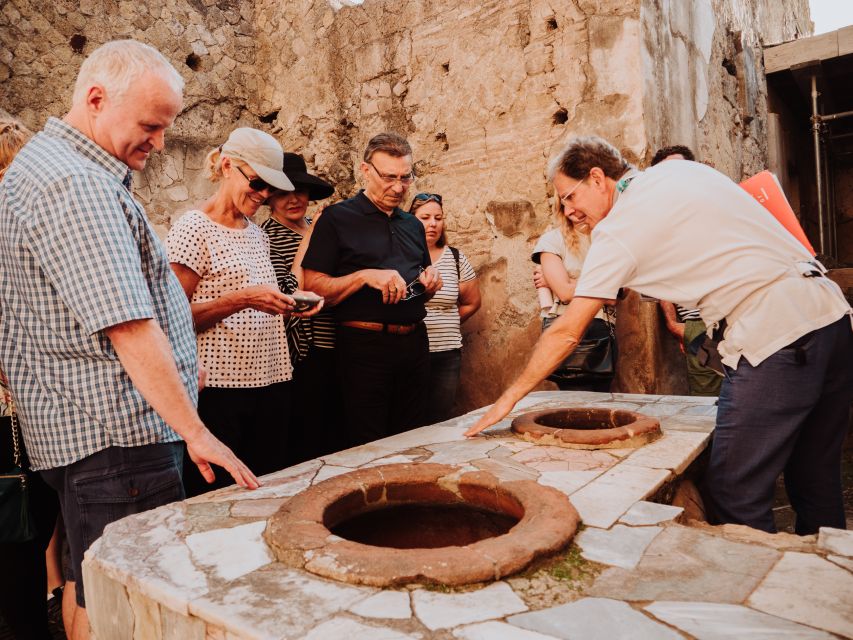
Herculaneum is much smaller, so the two-hour visit feels more concentrated. The heavy mud sealed buildings and household objects in place. You might see second floors, carbonized wooden items, intact paintings, and mosaics that make the private life of the town easier to picture.
I find the contrast useful. Pompeii helps you understand the shape and rhythm of an ancient city. Herculaneum brings you closer to the homes of wealthier residents and the materials they used every day. One site explains the town; the other lets you inspect its rooms.
Other Pompei Campania days travellers weigh against this one:
- Pompeii: Entry Ticket and Guided Tour with an Archaeologist
★ 4.8 · 19,459 reviews - Pompeii: Small Group Tour with an Archaeologist
★ 4.8 · 12,264 reviews - Pompeii: Skip-the-Line Entrance Ticket with Audio Guide
★ 4.0 · 2,509 reviews
Meeting at Porta Marina Inferiore
The tour begins at Piazza Porta Marina Inferiore, 1, on the left side of Pompeii’s entrance called Porta Marina Inferiore. Look near the Arte bus stop for a guide holding an Askos Tours sign.
The meeting place is only a few minutes from the Pompei Villa dei Misteri Circumvesuviana station, which makes the location practical if you arrive by train. Still, Pompeii has several entrances and many tour operators gather near the archaeological site. Give yourself time to find the right person, especially since the meeting area may not have a large, obvious sign or umbrella.
The published coordinates are 40.7470817565918, 14.484834671020508. I would save those before leaving your hotel. The group waits for everyone before entering, so arriving promptly helps protect your time inside.
Tickets for both archaeological sites are provided, and the tour is designed to skip the ticket line. You should still bring a passport or ID card, since it is listed as required. The tour is offered in English or Italian.
Two hours inside Pompeii
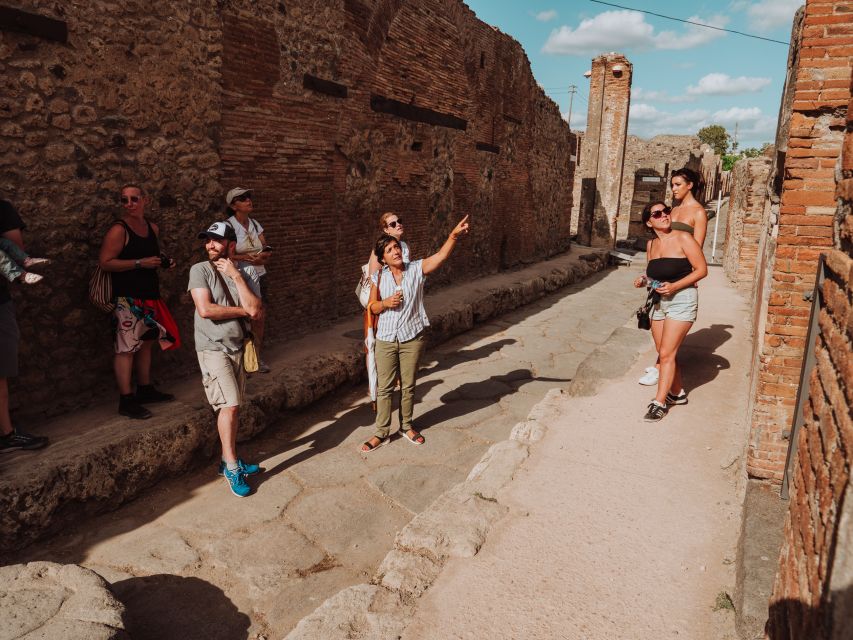
The first guided walk lasts about two hours. This is enough time to see important sections with a guide, but not enough to cover every corner of Pompeii. That is a good thing for many people. The site is so large that a focused route is more useful than a rushed attempt to see everything.
Pompeii’s power comes from ordinary details. The streets, walls, homes, and public spaces show how Roman life was organized. Ash preserved objects and building materials in remarkable condition, while the plaster casts of victims provide a painful reminder that this was a real disaster, not a museum display created for effect.
A strong guide gives you a way to read the ruins. A wall inscription, a room layout, or a decorative floor means more when someone explains how it fits into Roman daily life. Guides such as Diego, Alfredo, Paolo, Amedeo, Antonio, and Vincenzo have been especially praised for making complicated subjects clear and for answering questions during the walk.
The best part of a small group is that you can hear those explanations without standing shoulder to shoulder with a large crowd. Groups can still reach 20 people, so this is not the same as having a private guide. But it is small enough for the guide to manage questions and move the group through busy areas.
The amount of walking deserves serious attention. Pompeii has uneven ancient paving and very little comfort built into the route. Wear shoes with good support, not sandals that leave your feet exposed to rough surfaces. In hot weather, the open ruins can feel intense. One guide, Antonio, was praised for taking care of the group in high heat and using shade where possible, but you should still bring water, sunglasses, and a hat.
Headsets are provided for groups of more than 10. That matters when the group reaches its full size or when other groups are nearby. You can keep moving while listening instead of crowding around the guide.
The 30-minute pause after Pompeii
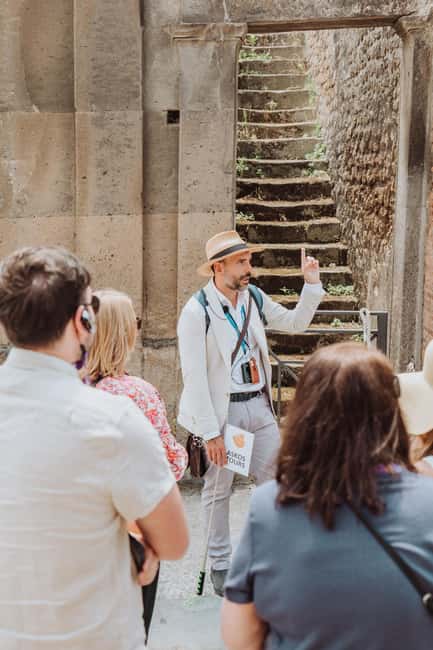
After the Pompeii visit, you get a break of about 30 minutes. This is intended for lunch, a quick snack, the toilet, or a look at the souvenir shops outside the ruins.
Here is the practical catch: half an hour is tight. You may have enough time to buy a sandwich and use the restroom, but not enough for a relaxed meal. Several people found that the break felt too short after two hours of walking, particularly in strong sun. Seating can also be limited, and you may end up eating quickly rather than taking a real rest.
I would treat this as a snack stop, not lunch at leisure. Bring something small with you if possible, or know exactly where you want to buy food before the tour begins. If sitting down for a cool meal is important to you, this schedule may feel rushed.
The advantage is that the tour keeps moving. A longer break would make the day easier on your feet, but it would also reduce time at one of the archaeological sites. If you want both Pompeii and Herculaneum in a single morning and afternoon, the compact schedule is part of the tradeoff.
A different way to spend the day, same part of Italy:
- Naples: Pompeii and Mt. Vesuvius with Lunch and Wine Tasting
★ 4.5 · 2,454 reviews - Pompeii: Skip-the-line-Ticket and Guided Tour
★ 4.6 · 1,152 reviews - Pompeii: Guided Tour with Skip-the-Line Entry
★ 4.9 · 812 reviews - Pompeii: Skip-the-Line Entry Ticket with Digital Guide App
★ 4.1 · 770 reviews
The train from Pompeii to Ercolano
After the break, the group travels by the Circumvesuviana train to Ercolano, the modern town beside Herculaneum. The ride itself takes about 20 minutes, while the itinerary allows around 30 minutes for the transfer.
This is a useful part of the plan because it connects the two sites without requiring a private vehicle. The guide stays with the group and can continue explaining the area during the transfer. One reported train delay was caused by a medical emergency, and on another occasion the operator used a private minibus when train service caused trouble. Those examples show that local transport can be unpredictable, even when the company handles the problem well.
You should not expect luxury transport. This is a regular commuter train, not a sightseeing coach. The benefit is simple: you move between the sites in the same way many people in Campania do, and you avoid arranging a separate transfer.
The tour does not return you to Pompeii. It finishes at Parco Archeologico di Ercolano. If your car, hotel, or onward train is back in Pompeii, plan the return before booking. One practical option mentioned in the tour information is the local commuter train, though the Ercolano station involves an uphill walk of roughly 25 minutes. If you are driving, you will need to make your own parking and return arrangements.
Two hours at Herculaneum
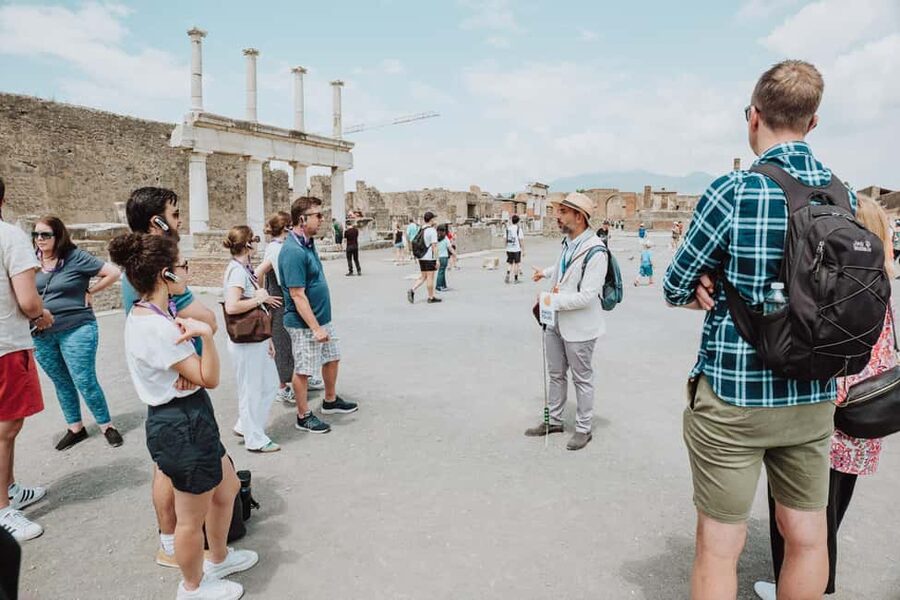
The second guided walk lasts about two hours. Herculaneum is smaller than Pompeii, but I consider it essential if you have made the effort to visit the area. Its preservation gives the site a different mood and a sharper sense of domestic life.
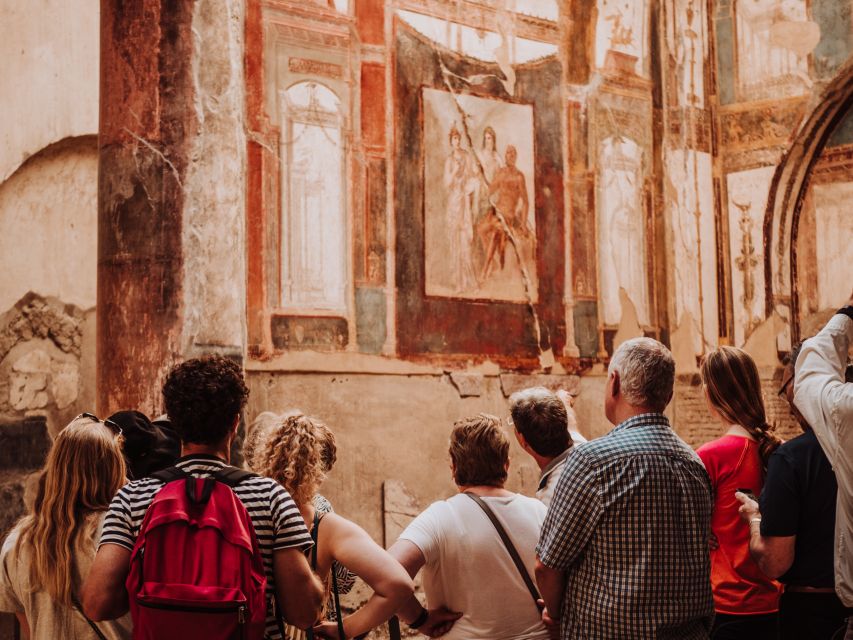
The mud that covered Herculaneum sealed wooden objects and upper levels of buildings. Paintings, mosaics, and wall decoration can appear startlingly complete. You may find it easier here to imagine the rooms as lived-in spaces rather than as fragments spread across a large city.
The town also gives a clearer look at the lifestyle of wealthier Roman residents. Decorative floors, painted walls, and household details show how much care went into private homes. The guide’s job is especially important because the objects can look beautiful without immediately explaining their purpose or place in society.
Guides including Paulo, Sergio, Rafael, and Amedeo have been praised for connecting the physical remains with daily life. That means you are not just looking at a mosaic. You are considering who used the room, what the decoration signaled, and how the building fit into the town.
Herculaneum can be emotionally powerful as well. Pompeii’s plaster casts make the human cost of the eruption direct and unsettling. Herculaneum’s preserved rooms create a different response, showing what people owned and how they lived just before the catastrophe. Seeing both sites gives you a fuller picture than choosing either one alone.
What the guides add
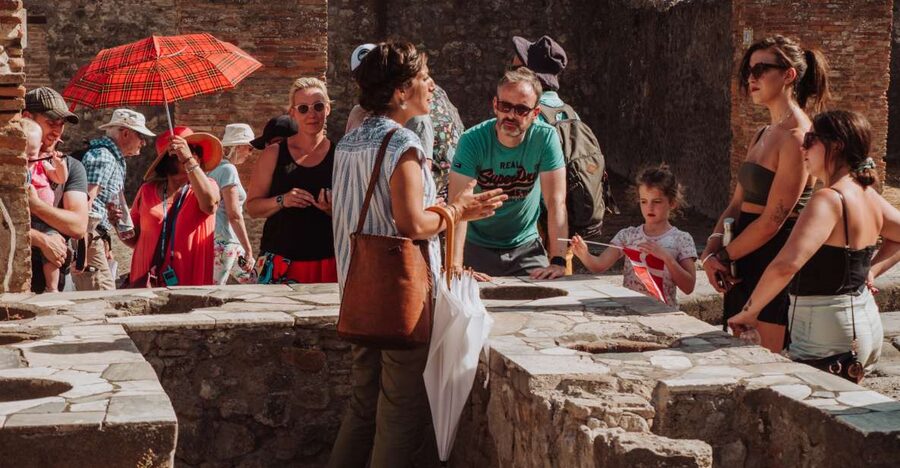
This experience depends heavily on the guide, and the guide names appearing most often in the strongest feedback include Diego, Paolo, Alfredo, Vincenzo, Amedeo, Antonio, Sergio, Julia, Rafael, and Ricardo. The descriptions are consistent: clear history, entertaining stories, patience with questions, and a talent for helping you picture ancient life.
That matters at Pompeii and Herculaneum because the ruins do not explain themselves. There is not always enough information beside every wall, house, or object to tell you why it matters. An audio guide can give facts, but it cannot easily respond when you ask about a detail or adjust the pace when a crowded area becomes difficult.
The best guides also add context about excavations and preservation. You can learn what has been uncovered, what remains buried, and why some materials survived while others disappeared. One guide encouraged the group to reason about how people lived in the Roman period instead of simply reciting dates.
A group of up to 20 does mean you will share the guide’s attention. If you want long discussions at every stop or a route designed around your private interests, a private archaeologist tour would suit you better. For most people, this group size offers a good middle ground between cost and personal attention.
How much value do you get?
No tour price is provided here, so I cannot judge the exact cost against other operators. I can judge the structure. You receive guided visits to two major archaeological sites, entry tickets are arranged, and the transfer between Pompeii and Herculaneum is built into the day.
Herculaneum admission is listed at 16 euros for adults and 2 euros for EU citizens aged 18 to 25. That gives you a useful reference point when comparing the tour with a self-guided visit. You would still need to account for Pompeii admission, transport, and the value of hiring an archaeologist separately.
The strongest value comes if you would otherwise walk through the ruins without understanding what you are seeing. Pompeii is vast, and Herculaneum rewards close attention. A guide can help you spend two hours at each site on the sections that matter most instead of losing time over a map.
The weaker value appears if you want a slow day. Five and a half hours is a compact schedule with two substantial walking tours, a short break, and a train transfer. It is efficient, but not restful.
Who should book this tour?
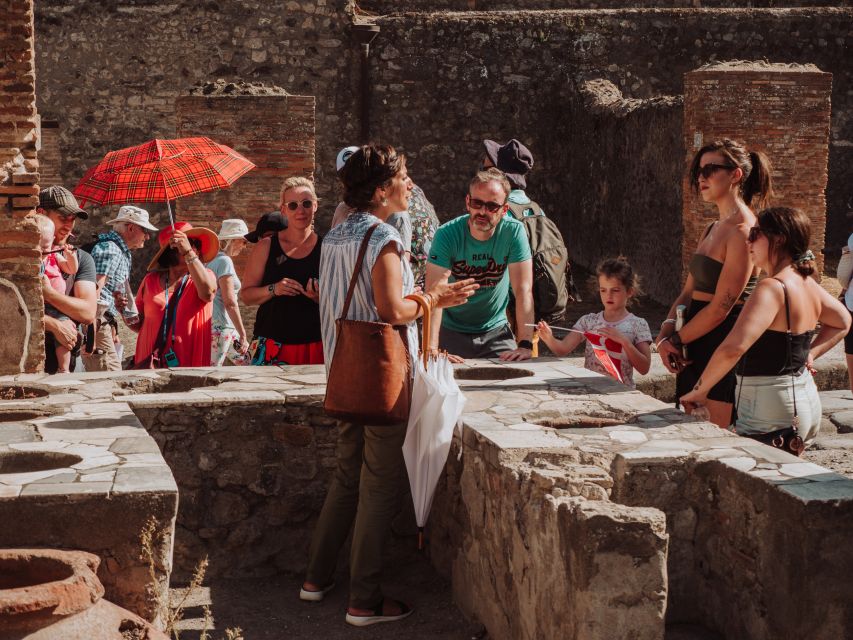
I would choose this for a first visit to Pompeii and Herculaneum, especially if you have limited time in Campania or are making a day trip from Rome. It also suits history fans, families with older children, and anyone who prefers stories and explanation to wandering alone.
The tour can work for a mixed-age group because several guides use humor and keep the material lively. Children still need to manage a long day on their feet, heat, uneven ground, and a fairly serious subject.
I would think twice if you have mobility limitations. The activity is explicitly not suitable for wheelchair users or people with mobility impairments. The rough surfaces, extended walks, station transfer, and final uphill route from Ercolano station can make the day difficult.
Also reconsider it if lunch is a major part of your sightseeing style. The 30-minute break is enough for a fast bite, not a leisurely restaurant meal. Plan food and water in advance.
Practical tips for a smoother visit
Wear comfortable clothes and firm walking shoes. Bring water, sunglasses, and a hat in summer, and carry a raincoat or poncho because sudden showers can occur.
Save the meeting-point details and look specifically for the Askos Tours sign near Porta Marina Inferiore. Do not assume every person near the entrance represents the same company.
Bring your passport or ID card. If you are an EU citizen aged 18 to 25, carry proof of age and eligibility for the reduced Herculaneum admission listed at 2 euros.
Expect the day to end in Ercolano, not Pompeii. Arrange your onward trip before you arrive, especially if you have a train reservation, rental car, or hotel booking in another town.
The activity allows free cancellation up to 24 hours before departure, and you can reserve now and pay later. That flexibility is useful when your Campania plans depend on weather or transport.
Should you book it?
Book this Pompeii and Herculaneum tour if you want the ruins to make sense, not just look impressive. The archaeologist-led format, manageable group size, included entry arrangements, and carefully chosen pairing of the two sites offer strong practical value.
The key compromises are the short lunch break, extensive walking, regular commuter train, and lack of return transport from Herculaneum. If those fit your plans, this is a smart way to see both cities in one day. If you want more time, a private tour or separate visits would give you a slower pace.
FAQ
How long does the Pompeii and Herculaneum tour last?
The tour lasts 5.5 hours. It includes about two hours at Pompeii, a 30-minute break, the train transfer, and about two hours at Herculaneum.
Where does the tour begin?
Meet at Piazza Porta Marina Inferiore, 1, on the left side of Pompeii’s Porta Marina Inferiore entrance, near the Arte bus stop.
How do I recognize the guide?
Look for a guide holding an Askos Tours sign.
Which languages are available?
The tour is conducted in English or Italian.
Are entry tickets included?
Entry tickets for both Pompeii and Herculaneum are provided as part of the activity. The listed Herculaneum admission is 16 euros for adults and 2 euros for EU citizens aged 18 to 25.
How do I travel from Pompeii to Herculaneum?
The group uses the Circumvesuviana train to Ercolano. The train ride is about 20 minutes, with around 30 minutes allowed for the transfer.
Does the tour return to Pompeii?
No. The tour finishes at Parco Archeologico di Ercolano, so you must arrange your own return or onward transport.
Is lunch included?
No lunch is included. There is a 30-minute break after the Pompeii visit for food, rest, shopping, or the restroom.
Is the tour suitable for wheelchair users?
No. The activity is not suitable for wheelchair users or people with mobility impairments.
Recently reviewed around Pompei Campania
- Pompeii 3hours Villa of Mysteries tour with an Archaeologist★ 4.8 · 486 reviews
- Pompeii: Skip-the-Line Entry & Audioguide★ 3.8 · 225 reviews
- Pompeii: Skip-the-line-Ticket and Guided Tour★ 4.6 · 1,152 reviews
- Pompeii: Guided Tour with Skip-the-Line Entry★ 4.9 · 812 reviews
- Pompeii: Tour with Archaeologist Guide & Skip-the-Line Entry★ 4.5 · 478 reviews
- Pompeii: Afternoon to Sunset Guided Tour with Ticket★ 4.9 · 484 reviews
- Pompeii: Skip-the-Line Entry Ticket with Digital Guide App★ 4.1 · 770 reviews
- Pompeii: Day Tour of Pompeii and Vesuvius with Bus Transfer★ 4.2 · 250 reviews
Pompeii & Vesuvius Tours, compared.

Entry Ticket and Guided Tour with an Archaeologist
Read our review →




Pompeii Small Group Tour with an Archaeologist
Read our review →
Pompeii, Amalfi Coast and Positano Day Trip from Rome
Read our review →Browse the lists this tour appears in