
Review · POMPEII & VESUVIUS TOURS
Pompeii: Tour with Archaeologist Guide & Skip-the-Line Entry
Pompeii is not just a field of broken columns. It is a Roman city caught in mid-sentence, with homes, shops, roads, baths, theaters, and plaster casts still showing how people lived before Vesuvius buried the town in AD 79. This two-hour guided walk helps you read those remains instead of simply wandering past them.
I like the skip-the-line entrance and the way an authorized archaeology guide adds meaning to small details, from road design to horse tie points. I also like that the guide usually gives you advice for staying inside after the tour, so your visit does not have to end when the two hours are up.
The main drawback is pace: Pompeii is huge, and two hours covers the key stops rather than the whole site. You should also expect some practical limits, including no bags, limited suitability for people with mobility impairments, and a meeting point that can take a little care to locate.
In This Review
- Key things to know before booking
- Why a guide changes Pompeii
- Entering through Porta Marina
- Teatro Piccolo and Pompeii’s public life
- House of Menander: a closer look at domestic Pompeii
- Thermopolium and the smell of ancient street food
- Stabian Baths and the Roman routine
- The Lupanare and Pompeii’s less polished side
- The Civil Forum, the tour’s big finish
- What the $57 price really buys
- Languages, group size, and the audio system
- Meeting point and simple preparation
- Who will get the most from this tour
- Should you book the Pompeii archaeology tour?
- FAQ
- How long does the Pompeii guided tour last?
- What is included in the price?
- Which languages are available?
- Do I need to bring identification?
- Are bags allowed inside Pompeii?
- Is the tour suitable for wheelchair users?
- Can I cancel the booking?
Key things to know before booking

- The tour covers seven major areas: Porta Marina, Teatro Piccolo, the House of Menander, Thermopolium, Stabian Baths, the Lupanare, and the Civil Forum.
- The guide is the main reason to book: Guides such as Angelo, Mario, Teresa, Lilian, Paolo, Roberta, and Imme have been praised for clear explanations, humor, and strong command of Pompeii.
- Two hours is an introduction, not a full-day visit: You see the main highlights, then can remain at the site to explore on your own.
- Audio equipment helps in crowded areas: A radioguide is used when the group passes eight people. Smaller language groups may use an audio guide with a guide in English.
- The price is sensible for a first visit: At $57 per person, the ticket, queue-saving entry, and specialist commentary make this more useful than entering alone if you have limited time.
- Plan for a meeting-point check: The listed start is the Welcome box at Guide Pompei. Allow time to find it and bring the names and ages of everyone in your group.
Why a guide changes Pompeii
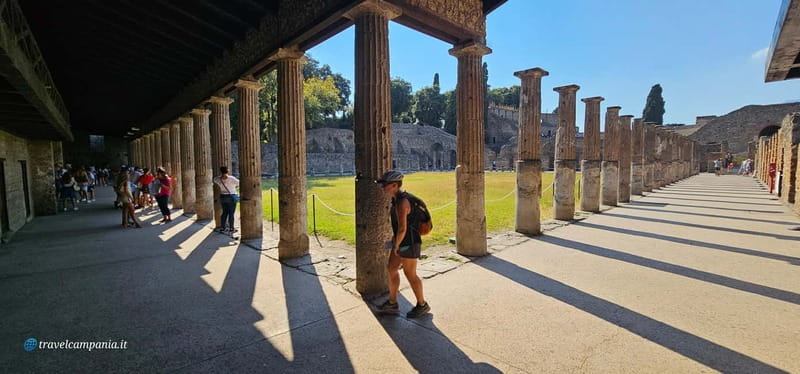
Pompeii can look obvious at first. You see walls, paving stones, faded paintings, and open doorways. The trouble is that the site rarely explains itself in a tidy order. A guide supplies the missing connections: what a room was for, how a house was arranged, what a shop sold, and how public buildings fitted into daily life.
That matters here because the city reaches back to the 7th century BC, while much of what you see reflects Roman life before the eruption. The remains are valuable not just because they are old, but because the ash preserved ordinary details. This is a place where art, trade, cooking, bathing, entertainment, religion, and social class appear in the same walk.
I especially value the focus on everyday life. The tour is not limited to grand monuments. It points you toward homes, food counters, public baths, and street details that help turn Pompeii from an archaeological site into a functioning town.
The guide also helps you avoid spending your short visit on the wrong corners. Several guides have been praised for choosing quieter spots when possible and for adjusting their explanations to different ages and nationalities. In crowded areas, the audio system lets you keep listening without standing shoulder to shoulder around the guide.
More Pompei Campania trips worth a second look
- Pompeii: Skip-the-Line Entrance Ticket with Audio Guide
★ 4.0 · 2,509 reviews - Pompeii: Skip-the-line-Ticket and Guided Tour
★ 4.6 · 1,152 reviews - Pompeii: Guided Tour with Skip-the-Line Entry
★ 4.9 · 812 reviews
Entering through Porta Marina
The tour begins at the meeting point and then moves toward Porta Marina, one of the principal entrances to ancient Pompeii. The guided explanation here lasts about 10 minutes, giving you an early sense of how the city connected with the outside world.
This is a useful opening stop because entrances establish scale. Once you pass into the excavated city, the modern world falls away quickly, but it is still easy to lose your bearings. A guide can explain how the gate, streets, and wider city fit together before you begin moving through individual buildings.
The entrance area may also be where you first notice the practical side of the visit. Keep your passport or identity card, or an accepted copy, available. Bags are not allowed inside, and free lockers at the gates have been noted as useful for storing a backpack safely.
Teatro Piccolo and Pompeii’s public life
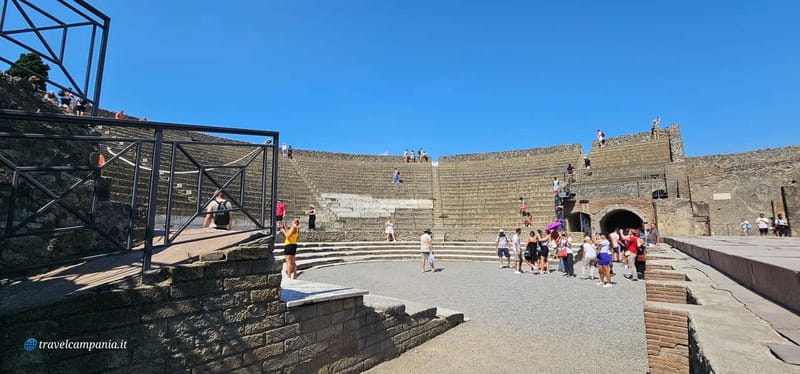
The next stop is Teatro Piccolo, or the Small Theater, with about 10 minutes of guided time. The theater offers a change of mood from streets and houses. Here, the guide can show how entertainment formed part of Roman public life and how the buildings were designed for performances.
Ten minutes is enough for an explanation and a look around, but not for a long pause. If theater architecture is your main interest, you may want to ask the guide what can be seen elsewhere before deciding how much extra time to spend after the tour.
This stop also shows the value of having someone identify what you are looking at. Without context, a theater can become another set of ancient stones. With a guide, its purpose and place in the city become much clearer.
House of Menander: a closer look at domestic Pompeii
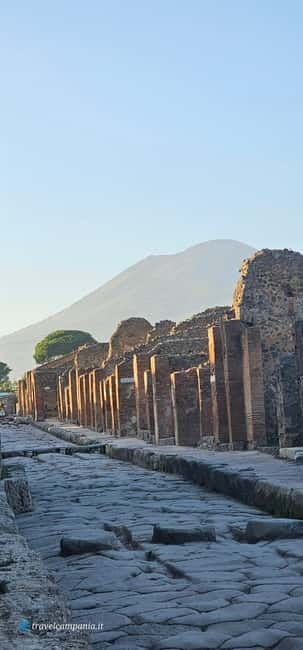
The House of Menander receives about 15 minutes. This is one of the tour’s strongest stops for seeing how a wealthy Roman home was organized and decorated.
The name comes from a painting of Menander, a Greek playwright, and the house gives the guide room to discuss art, domestic space, and social rank. You are not simply looking at a facade. You are being shown how rooms worked together and what decoration could say about the owner.
I like this part of the route because it balances the public buildings. Pompeii becomes more personal here. You can begin to picture households, visitors, servants, meals, and the careful display of status that shaped Roman homes.
Do not expect every room to be open or every painting to be equally clear. The site is large and preservation conditions vary. The guide’s job is to point out the important details before the route moves on.
A different way to spend the day, same part of Italy:
- Pompeii: Entry Ticket and Guided Tour with an Archaeologist
★ 4.8 · 19,459 reviews - Pompeii: Small Group Tour with an Archaeologist
★ 4.8 · 12,264 reviews - Naples: Pompeii and Mt. Vesuvius with Lunch and Wine Tasting
★ 4.5 · 2,454 reviews - Pompeii: Small-Group Tour of Pompeii and Herculaneum
★ 4.8 · 867 reviews
Thermopolium and the smell of ancient street food

The Thermopolium, visited for about 15 minutes, is one of the most memorable stops for many first-time visitors. This was a food and drink counter, the Roman equivalent of a quick meal shop.
The stop is valuable because it takes Pompeii beyond temples and villas. It shows commerce at street level, where ordinary people bought food and drink during the day. A counter may look simple, but it opens a window onto work, trade, and eating habits.
This is also the sort of place that benefits from a guide’s explanation of design. Small features can be easy to miss, and the guide can direct your eyes to the parts that reveal how the business functioned. You may leave this stop with a better sense of Pompeii as a working town rather than a collection of grand ruins.
Stabian Baths and the Roman routine

The Terme Stabiane, or Stabian Baths, take about 15 minutes. Roman baths were not merely places to wash. They were social and public spaces, and the building helps explain how residents spent time outside their homes.
The guide can help you follow the layout and understand the role of the different areas. That context is important because bath complexes often look like a confusing series of rooms when seen without explanation.
I find this section useful for understanding routine. After seeing a private house and a food shop, the baths add another layer: a shared place where people met, exercised, relaxed, and took part in a familiar Roman custom.
The stone surfaces can be uneven, and there is little sense in rushing through them. Wear firm shoes and watch your footing. The experience is not suitable for wheelchair users or people with mobility impairments, and the site’s ancient streets can make walking tiring.
The Lupanare and Pompeii’s less polished side
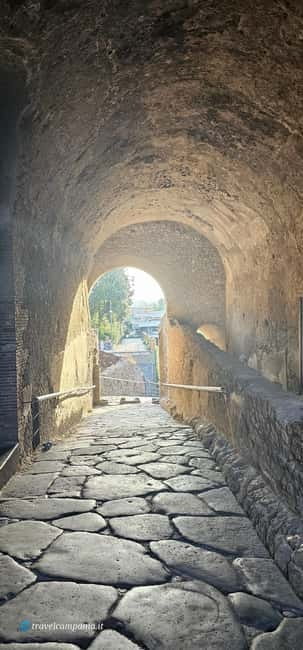
The route then reaches the Lupanare, with roughly 20 minutes of guided time. This is commonly identified as a brothel, and it is one of Pompeii’s most discussed buildings.
The stop can feel more direct than the grander monuments because it concerns sex work, commercial life, and the less respectable parts of the ancient city. A good guide keeps the explanation grounded in evidence and daily life rather than turning the building into a cheap joke.
The longer time allocation makes sense. This is a place where small details need interpretation, and groups may move slowly because the space is confined. Crowds can gather here, so the guide’s use of an audio system and choice of timing can make a real difference.
If you are visiting with children, consider their ages and your own comfort level. The activity requires participant names and ages when you book, and the site contains adult material.
The Civil Forum, the tour’s big finish

The final main stop is the Civil Forum, with about 15 minutes of guided explanation followed by 10 minutes of free time. The forum was the civic heart of Pompeii, so it is a fitting place to bring the short route together.
Here, the city’s public life comes into view on a larger scale. After seeing a theater, home, food counter, baths, and brothel, you can better understand how those places related to the center of town.
The free time is brief, but useful. You can take photographs, look back over the space, or ask a final question before the guided portion ends. The activity finishes back at the meeting point, yet you should check the site arrangements if you plan to remain inside and continue exploring afterward.
Several guides have offered suggestions for what to see next. Take advantage of that. Pompeii is too large to finish properly in two hours, and the best value comes from using the guided route as your orientation, then visiting additional areas at your own pace.
What the $57 price really buys
The cost is $57 per person. That includes the Pompeii Express entrance ticket and an authorized guide with archaeology expertise. Transport, lunch, and tips are not included.
I see the price as fair for a first visit, especially if you have only a morning or afternoon. You are paying not just to enter, but to avoid the ticket queue and gain a clear route through some of the site’s most useful buildings.
The value is strongest when you would otherwise have little preparation time. Pompeii rewards research, but many people arrive with only a general idea of what they are seeing. A guide fills in that gap quickly and helps you spend your energy looking rather than decoding.
The value is weaker if you already know Pompeii well or want to spend the entire day in one section. A group tour has a fixed route and fixed timing. You will not be able to linger at every house or change the order around your personal interests.
Tips are not included, but they remain optional. If a guide gives you strong explanations, handles a crowded route well, and offers useful advice for the rest of your visit, you can decide at the end if you want to leave something extra.
Languages, group size, and the audio system
The tour is offered in Italian, Spanish, French, English, and German. You should select carefully when booking and provide the names and ages of all participants.
The audio arrangement depends on group size. When the group passes eight people, a radioguide is included. If there are no more than four participants in the same language, the tour uses an audio guide along with a tour guide in English. That second arrangement is worth noting if you expect a fully spoken tour in your chosen language.
The equipment has generally worked well, though one practical issue is volume. It can be loud, especially in close quarters. Still, in a busy archaeological site, hearing the guide clearly is usually better than trying to follow a voice from several yards away.
Guides have been praised for being funny, patient, and able to explain complex points without making the walk feel like a lecture. Names that have received especially warm attention include Angelo, Mario, Teresa, Lilian, Liliane, Paolo, Roberta, and Imme. The guide assigned to your departure may be different, but these examples show the kind of approach to expect: clear, lively, and focused on real life in Pompeii.
Meeting point and simple preparation
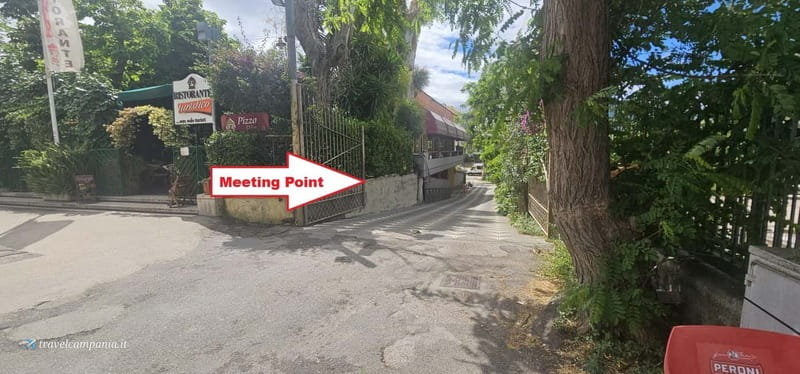
The start is listed as the Welcome box at Guide Pompei. Most of the time, the meeting process is straightforward, but one part of the experience deserves caution: finding the exact check-in spot can be confusing once you arrive.
I would not cut the timing close. Train delays and road confusion have caused some people to arrive late, though the provider has sometimes helped move bookings to a later departure or arranged general access when a guided start was missed. That flexibility is useful, but you should treat it as help, not a promise.
Bring your passport or identity card. A copy is accepted, and the same applies to children. Leave bags behind, and do not bring bikes, alcohol, or drugs.
Free lockers at the gates can help with a backpack. Water fountains inside the site have also been noted, although they may not be clearly marked. Wear shoes suited to uneven paving and give yourself enough time to find the meeting point before the start.
Who will get the most from this tour
I would choose this for a first visit, a short stay in Campania, or a day trip when you need the site to make sense quickly. It also suits anyone who prefers stories and context to reading every sign alone.
Families can benefit from the guide’s humor and ability to adjust explanations, though the Lupanare may call for parental judgment. The tour also works for mixed-age groups because it brings together buildings with different levels of visual interest.
It is less suitable if you use a wheelchair, have major mobility limits, or cannot manage uneven ancient streets. The activity is also not suitable for people over 95 years old according to the stated conditions.
You should book elsewhere, or enter independently, if you want a slow photographic visit with no fixed route. You should book this tour if you want a strong introduction and plan to stay afterward for more.
Should you book the Pompeii archaeology tour?
I would book it if Pompeii is new to you. The combination of ticket entry, queue-saving access, and an archaeology guide gives you a useful framework for a site that can otherwise feel scattered.
The strongest part is the human scale. You see a home, a food counter, baths, a theater, a brothel, and the forum, then begin to understand how one Roman town worked. Just remember that two hours is the starting point, not the complete Pompeii experience.
Arrive early, bring identification, keep your bags light, and plan extra time after the tour if your schedule allows. At $57, it is a solid choice for clarity and convenience, especially when a guide such as Angelo, Mario, Teresa, or Paolo turns a difficult ruin into a place you can actually picture.
FAQ
How long does the Pompeii guided tour last?
The guided tour inside the excavations lasts approximately two hours. The route includes guided stops and about 10 minutes of free time at the Civil Forum.
What is included in the price?
The price includes a Pompeii Express entrance ticket and an authorized guide with expertise in archaeology. Transport, lunch, and tips are not included.
Which languages are available?
The activity is available in Italian, Spanish, French, English, and German.
Do I need to bring identification?
Yes. You should bring a passport or identity card for each participant, including children. A copy of a passport or identity card is accepted.
Are bags allowed inside Pompeii?
Bags are not allowed. Free lockers at the gates have been noted as an option for storing a backpack safely.
Is the tour suitable for wheelchair users?
No. The activity is listed as unsuitable for wheelchair users and people with mobility impairments.
Can I cancel the booking?
You can cancel up to 24 hours in advance for a full refund. The reserve-now-and-pay-later option lets you hold a place without paying immediately.
Recently reviewed around Pompei Campania
- Pompeii 3hours Villa of Mysteries tour with an Archaeologist★ 4.8 · 486 reviews
- Pompeii: Small-Group Tour of Pompeii and Herculaneum★ 4.8 · 867 reviews
- Pompeii: Skip-the-Line Entry & Audioguide★ 3.8 · 225 reviews
- Pompeii: Skip-the-line-Ticket and Guided Tour★ 4.6 · 1,152 reviews
- Pompeii: Guided Tour with Skip-the-Line Entry★ 4.9 · 812 reviews
- Pompeii: Afternoon to Sunset Guided Tour with Ticket★ 4.9 · 484 reviews
- Pompeii: Skip-the-Line Entry Ticket with Digital Guide App★ 4.1 · 770 reviews
- Pompeii: Day Tour of Pompeii and Vesuvius with Bus Transfer★ 4.2 · 250 reviews
Pompeii & Vesuvius Tours, compared.

Entry Ticket and Guided Tour with an Archaeologist
Read our review →




Pompeii Small Group Tour with an Archaeologist
Read our review →
Pompeii, Amalfi Coast and Positano Day Trip from Rome
Read our review →Browse the lists this tour appears in